Independent Project · Demand & Supply Planning · 2026
Demand & Supply Planning Intelligence
Built a retail planning tool that evaluates demand forecasts, suggests purchases and stock transfers within operational and funding limits, and compares plans under changing conditions.
Demand Forecasting · Purchase & Allocation Planning · Scenario Analysis
- Decision views
- 3 demand review · plan review · scenarios
- Full sample
- 240 series 60 SKUs across 4 stores · synthetic Riyadh retail data
- Review window
- 28 days visible forecast · days 29–56 provisional
What I built
Demand & Supply Planning Intelligence evaluates forecast methods against past demand, suggests purchases and stock transfers within modeled supplier, stock, receiving and funding limits, and compares plans when assumptions change.
A forecast estimates demand. It does not establish whether stock is available, a supplier can deliver in time, a distribution centre can receive it, or weekly funding can cover the payment. The tool checks these modeled limits before proposing actions.
Data and results are synthetic and modeled throughout — a Riyadh retail network built for this project. Nothing here represents a company’s operations, and no figure is an observed result. It builds on my experience in demand planning, purchasing and inventory management.
Demand Review
Three weekday-aware forecast methods — seasonal naive, a four-week weekday mean and a recency-weighted weekday mean — are scored against withheld history in time order, so a method is chosen on how it performed before the day it is used, not on the data it was fitted to.
The screen reports the selected method and why it was selected, its quantity error against the seasonal-naive baseline, pooled signed bias separating over- from under-forecasting, and how many daily observations were actually scored. Dated fallbacks and data-quality warnings stay visible rather than being smoothed away.
The forecast runs 56 days. The first 28 are the visible review window; days 29–56 are shown as provisional and labelled that way wherever they appear. Expected demand is a model estimate, not a service guarantee.
Plan Review
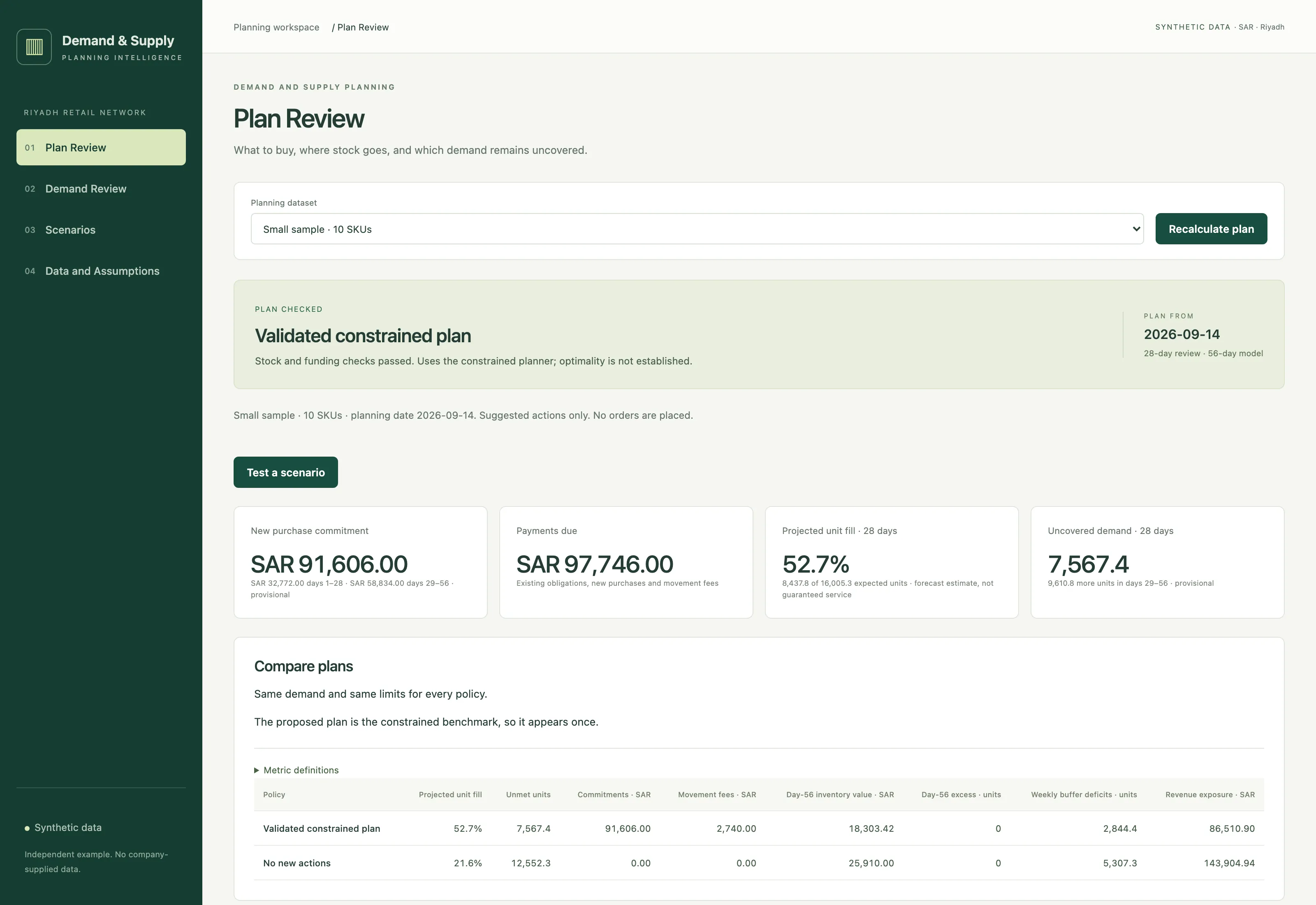
The plan answers three questions: what to buy, where stock goes, and which demand remains uncovered.
Purchases carry their supplier, order date, dispatch date, distribution-centre receipt date and value. Orders inside the next seven days are marked release candidates; later orders stay planned. Transfers move stock between locations, with the donor’s own forecast demand and buffer protected before any units leave it. Remaining shortages are listed per SKU and store with the reason they could not be covered, separated into visible and provisional-tail unmet demand.
Funding is dated, not a single budget line. Each week has a limit on new purchase commitments and a ceiling on cash due, and existing obligations count against that ceiling before anything new does. The screen shows commitments, payments, headroom and movement-fee allowance week by week.
Every plan is compared against taking no new actions, on the same demand and the same limits, so the plan’s coverage is readable against the alternative of doing nothing.
Scenarios
A scenario changes the assumptions — a promotion, a supplier receipt delay, reduced supplier availability, tighter weekly funding — and produces three outcomes side by side:
- Original — the starting plan under the original assumptions.
- Same actions — the original purchases and transfers evaluated under changed assumptions, without replanning.
- Replanned — new actions calculated under the changed assumptions.
The comparison separates the effect of the changed assumptions from the effect of replanning. Where the original actions become infeasible under the change, the plan is shown as invalid with the dated constraint that broke it, rather than reported as a worse number. Comparisons are estimates, not guaranteed savings.
How it works
Synthetic dataset → forecast evaluation → constrained plan → independent replay → scenario comparison
Planning is a mixed-integer program solved with SciPy’s HiGHS backend over the full 56-day horizon. Purchases and transfers are integer cases and packs, and the objectives run in sequence rather than as one weighted score: service shortfall by store priority first, then stock buffers, then cost. Each stage’s result is held fixed before the next one runs, so cost reduction cannot quietly trade away coverage. The model respects opening stock, supplier capacity and lead times, case and pack sizes, receiving-calendar and volume limits, and the dated funding limits above.
The resulting plan is then replayed independently against the same constraints, day by day,
to confirm it is actually executable. A plan that passes is reported as feasible_fallback:
it satisfies every constraint and has been checked, but it makes no claim of global
optimality, and shortages stay visible rather than being absorbed. The tool suggests; it
does not place orders.
Build approach
- Calculation in code. Forecast scoring, constraints, the solver and the replay check are defined in code. No language model is involved in producing a number, a suggestion or a comparison.
- Independent verification. The plan is validated by a separate replay rather than by trusting the solver’s own answer, so an infeasible plan surfaces as a failure instead of a recommendation.
- Public demo runs on sample data. Two bundled synthetic datasets are available: a 10-SKU sample and a 60-SKU full sample of 240 SKU-store series. Workbook upload, review, acceptance and export are built and work locally or in Docker, but they depend on private storage that is intentionally unavailable on the public host.
- Development. I used Claude and Codex for implementation and QA, while defining the planning rules, constraints and expected outputs explicitly and validating results against the replay check and an automated test suite.