Independent Project · Freight Marketplace Operations · 2026
Freight Fulfillment Intelligence
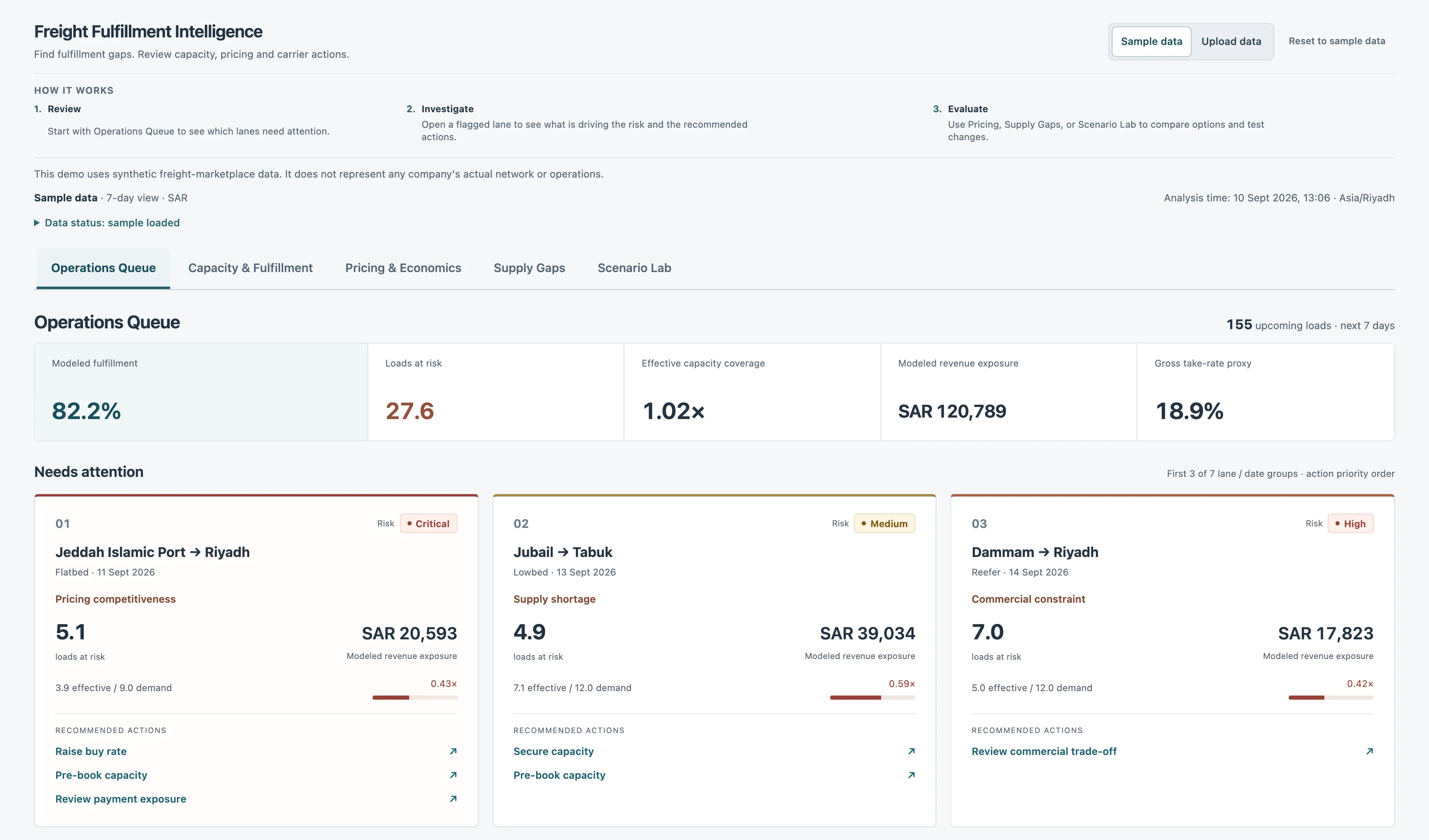
Built a freight-marketplace decision tool that shows which upcoming loads are at risk, what is driving the risk and what Operations should do next.
Fulfillment Risk · Carrier Capacity · Pricing & Economics
- Scenarios
- 6 pricing · capacity · commercial · concentration · service · normal operations
- Upcoming loads
- 155 scheduled over the next 7 days · synthetic MENA data
- Decision model
- Rule-based deterministic analytics · optional AI narration
What I built
Freight Fulfillment Intelligence is a decision-support tool for freight marketplaces. It shows which upcoming loads are at risk, what is driving the risk and what Operations should do next. It combines demand, carrier capacity, historical acceptance and reliability, and rate data to explain what is driving the risk.
A freight marketplace can have enough trucks available on paper and still struggle to cover demand. Capacity only becomes useful when the right equipment is available on the right lane, carriers are likely to accept the rate, service is reliable and the economics still work.
The project uses synthetic MENA freight data and does not represent any company’s actual network or operations. It builds on my experience working with freight pricing, lane, shipment and carrier data at Amazon.
Core decisions
Capacity coverage
Compares upcoming demand with qualified and effective carrier capacity to separate physical shortages from capacity that looks available but is unlikely to convert.
Pricing & economics
Tests whether higher carrier buy rates improve modeled acceptance and coverage without breaching the commercial floor.
Service & concentration
Shows when reliability or dependence on a small carrier group is reducing usable capacity.
Operator actions
Prioritizes actions such as securing capacity, activating backup carriers, raising buy rates, pre-booking supply or reviewing a commercial trade-off.
How it works
Upcoming demand + carrier capacity + history → effective capacity → fulfillment risk → root cause → recommended action → scenario testing
The tool uses four required datasets: upcoming loads, carrier capacity, historical loads and historical carrier offers. Carrier payments are optional.
Users can inspect Capacity & Fulfillment, Pricing & Economics and Supply Gaps, then use Scenario Lab to test changes against the same baseline decision engine.
Build approach
- Decision logic. Calculations, risk classification, root-cause logic and recommended actions are defined in code rather than generated by a language model.
- Scenario testing. Baseline and changed assumptions use the same deterministic analytics engine, so the comparison stays consistent.
- Local processing. CSV parsing, validation, analytics and scenarios run in the browser. Raw uploaded files are not stored or sent to the AI provider.
- Operations Brief. DeepSeek can turn already-calculated results into a short summary when requested. It does not change calculations, priorities or recommendations.