Independent Project · Supply Chain Analytics · 2026
Supply Chain Workbench
Built a supply-chain workbench that calculates reorder needs, flags freight exceptions and scores supplier performance from CSV data, with AI-generated action summaries.
Inventory Planning · Freight Analytics · Supplier Performance
- Workflows
- 3 reorder planning · freight exceptions · supplier scoring
- Data input
- Flexible CSV automatic + manual field mapping
- Processing
- Local calculations run in-browser · no database
What I built
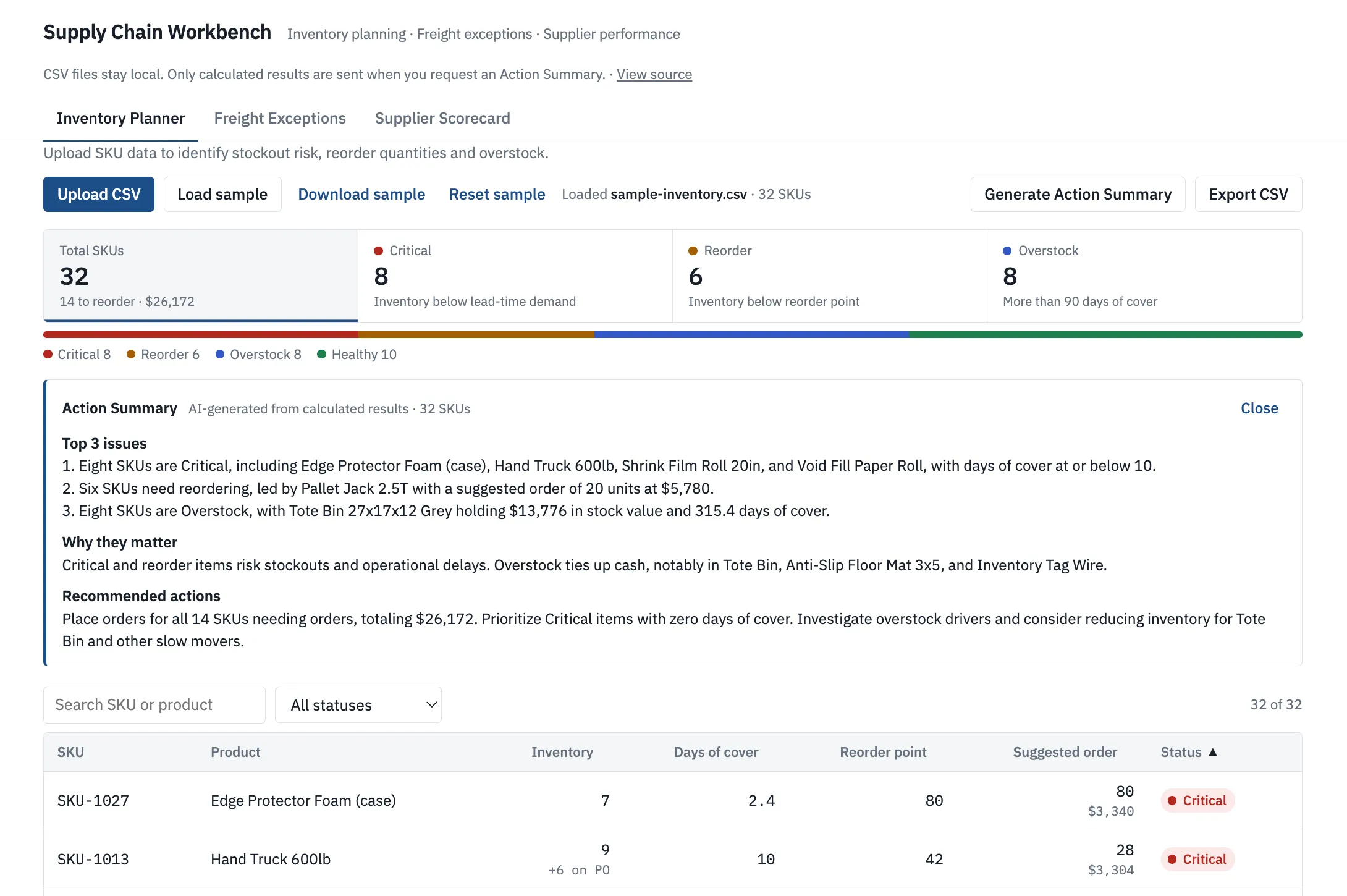
Supply Chain Workbench combines three recurring analyses in one interface: inventory planning, freight exception analysis and supplier performance scoring. Each workflow calculates results from uploaded CSV data; DeepSeek generates an Action Summary from those results when requested.
Three workflows
Inventory Planner
Calculates days of cover, lead-time demand, reorder points, inventory position and MOQ-rounded order recommendations.
Freight Exceptions
Compares cost per mile with the lane average and flags shipments that are high-cost, late or both.
Supplier Scorecard
Scores supplier delivery, quality, cost and service with configurable weights. Missing required data is marked Incomplete rather than forced into a score.
How it works
Upload CSV → map fields → analyze → review results → export CSV or generate Action Summary
You do not need exact header names. Common variants are matched automatically—for example, Stock On Hand, on_hand and Quantity On Hand all resolve to the same field. If a required field cannot be matched, select it manually before analysis. Unused columns are ignored.
Build approach
- Development. I used Claude and Codex for implementation, iteration and QA, while defining the supply-chain rules and expected outputs explicitly and validating them against known results.
- Calculation logic. Inventory, freight and supplier calculations are defined in code rather than generated by a language model.
- Local processing. Uploaded CSV data is parsed and analyzed in the browser. No database is required and session data is not persisted.
- Action Summary. DeepSeek generates a short summary from already-calculated structured results when requested. Raw uploaded CSV files are not sent to the AI endpoint.